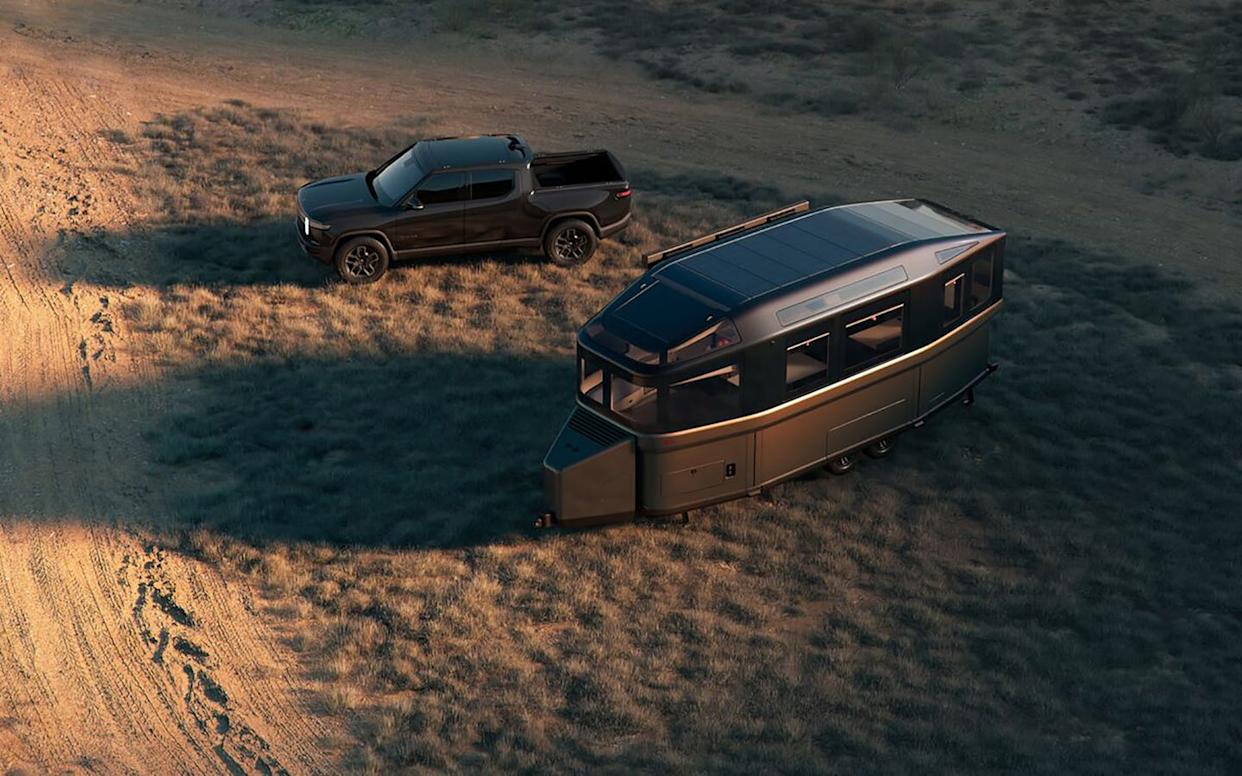
Lightship starts producing its electric RV trailer, which features a battery to help propel the tow vehicle and power other amenities.
The TrekDrive system can double the range of the tow vehicle if it's electric, or double its mpg if it's ICE-driven, the company says.
The RV is offered in 44- and 77-kWh versions, and also features solar panels.
The arrival of the EV era meant that quite a few other vehicles would change as well, and this includes recreational vehicles.
Colorado-based Lightship has just started producing its AE.1 Cosmos Edition all-electric RV trailer, while also adding two new trims dubbed AE.1 Atmos and AE.1 Panos.
The main value proposition of having an electric RV at all is being able to boost the range of the tow vehicle itself, but there are a few other benefits.
Lightship's own TrekDrive system can double the range of the tow vehicle if it's electric, or double its mpg if it's ICE-driven.
The trailer is self-propelled, but it also uses the company's proprietary smart hitch with two-way force sensing that connects the tow vehicle to the trailer.
Via this smart hitch, the trailer can use additional power on uphill climbs and apply controlled braking when going downhill.
Atmos Priced Like a House or Condo
"Operating independently, it senses acceleration, braking, and cornering forces, then adjusts in real time for smooth, synchronized support," the company notes.
AE.1 Atmos with TrekDrive vehicle assist features a 77-kWh battery system (with a NACS charger) and 1.8 kW of integrated solar roof panels. Yes, we're talking about a battery here that's larger than in a lot of EV hatchbacks. And this comes with its own costs.
The starting price is $184,000, which is... perhaps reasonable if you look at house or condo prices these days.
"We've engineered these models to meet adventurers where they are," explained Ben Parker, Lightship Co-Founder and Chief Product Officer.
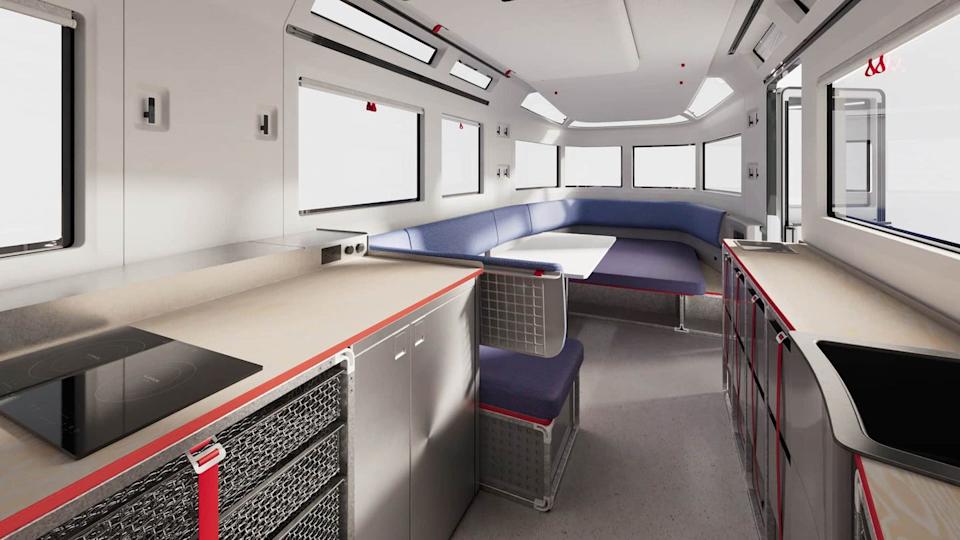
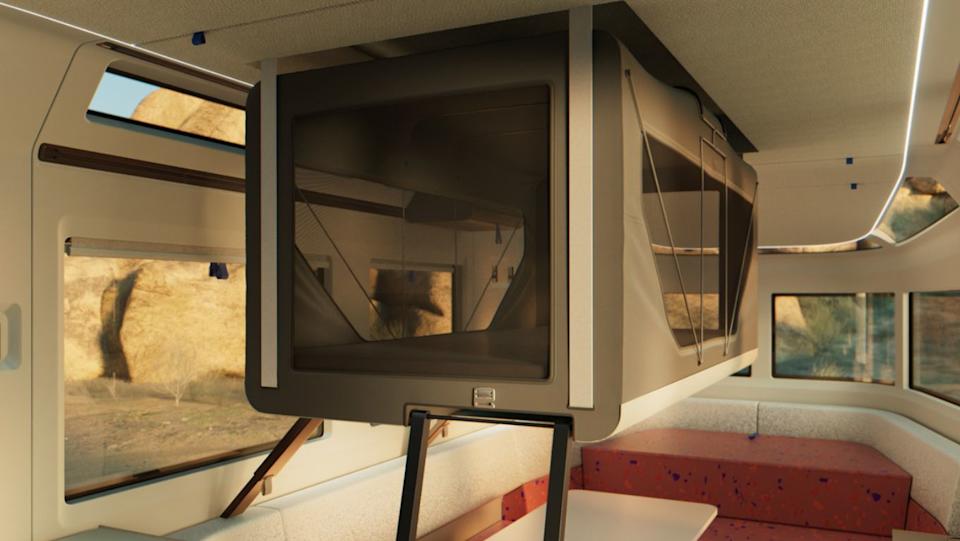
The AE.1 Panos, on the other hand, has a smaller 44-kWh battery and 840 W of solar roof panels, in addition to a third-bed add-on just like Atmos.
And the Panos trim starts at a more reasonable $151,000.
What’s the Ideal Tow Vehicle?
The Cosmos Edition is the launch version with all the trimmings, and it's going into production first.
"The Cosmos Edition proved that the market is hungry for electric RVs that don't compromise on performance or design," said Toby Kraus, Lightship Co-Founder and CEO.
"Atmos and Panos bring our vision of sustainable adventure to more families and adventurers, regardless of their camping style."
Yes, you still need something with which to tow the AE.1 Cosmos, and with the Chevy Silverado EV Work Truck having just set a frankly ridiculous range record of 1059.2 miles, we'd probably put it at the top of our list.
But the Rivian R1T pictured at the top will do just as well, we suspect.
The long-awaited Volkswagen ID. Buzz also comes to mind, and perhaps makes more sense than any other truck as it could certainly use more range.
More importantly, the Lightship's AE.1 previews a future in which most RVs will have extensive EV hardware on board to help power the towing vehicle and the features of the EV itself.
And having an EV-size battery on board is just one part of the equation.
It remains to be seen whether the Lightship RV, as futuristic as it seems, will find a large enough audience among RV owners who will use EVs to tow the trailer, but it's nice that it can provide extra power to internal-combustion-engined vehicles as well.

Another question is whether RV buyers can justify the cost of having a 77-kWh battery in their trailers, no matter how much more convenience or range it can offer.
But just how far we are from a time when most RVs will feature large EV batteries is perhaps a more difficult question to answer.
Will most new RV trailers in 2035 feature some kind of EV battery and drive system, or will this remain a niche technology? Let us know what you think in the comments below.



Comments